Thursday, 15 August 2013

Is CBA the best bank in the developed world?

Yesterday the Commonwealth Bank of Australia reported and although I've always been cynical about the Australian banks and their performance it's hard to argue with some of the numbers they've put up in the last few years. CBA is up over 30% in the last year and it's been able to produce an RoE of 18.4%. That's impressive given we've been getting used to banks talking about a 10% RoE as being the new norm.

There's no doubt that the current rates cycle in Australia is nearly over and that the bank will have to look forward to the swing up in funding costs and probably an increase in non-performing loans in the next few years, but until then all they have to do is make some prudent funding decisions and they should have a sufficient buffer to do deal with any problems. As with all Australian banks the two areas I'm most interested in are the source and duration of funding and the current shape of the loan portfolio. Here are the charts from the investor presentation that caught my eye:


Retail sales in Australia have been dismal for some time and therefore one might have suspected that consumer credit arears may have been going up as some sign of economic stress. The above chart though shows a surprisingly benign environment even given the uptrend in the arrears on personal loans . Clearly mortgage stress is also not the problem within the portfolio that many bears on Australia might have thought. 
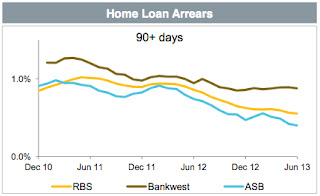

And here's the home loan situation magnified to show the major divisional units. I suspect that the figures for Bankwest might be tracking down as CBA plays with the mix of customers that they direct to the unit; meaning that jumbo mortgages probably get put in one of the other units that might be better placed to monitor a borrowers credit status. 


The current liquidity and source of funds is looking better than previously reported. Remember that the bears have always raised question about the funding of the big 4 Aussie banks loan books based on the fact that so much is sourced overseas. Well that's still a concern, but the shock of 2008 is clearly starting to move them away from this model.

Normally investors might have been happy to get a special dividend as competitor Westpac have recently announced, but management has decided to stay comparatively over capitalised as we get closer to full Basel III implementation. I also seem to remember that you just might be doing shareholders a favour if you see growth opportunities out there while simultaneously running an 18% RoE.

Finally CBA could be the best bank in the world, but that doesn't make it the cheapest. It's trading on a PBR of over 2x.


It's share price is close to all time highs and Australia as a whole still has to face up to a slowing demand from China. If you had it in your portfolio you wouldn't be selling it aggressively, but you may want to keep an eye on it so as to fund another position in your portfolio.

The AUD bounced back above 90 cents partly as response to the iron ore price's continuing upward move and partly because of the recent disclosure of an update by the Australian Treasury. Iron Ore is now back at the $140 per ton level. Nomura estimates that there is an excess 400m tonnes of the steel currently in the system as we go into the seasonally weak period for iron ore. Given this it would seem foolhardy to see the current move as having any real fundamental support and therefore investors in AUD assets need to adopt an appropriate attitude.

I had some notes recently commenting on the weather in Sydney and the high winter temperatures. The cycling opportunities have been everywhere, I just haven't managed to get out of town. There's a few events come up around Sydney including a Wiggle.com.au event in the Hunter Valley that I've entered.


It's a nice area of the world and as long as the mining trucks are off the road it should be a great day. I chose the 120km ride as the 175km is just too much for me. You see I'm almost bored by the time I get to the 100k mark and just want to finish. Of course it will depend on the type of day and the number of metres to climb, but in my case I'm betting I can average around 25kph or so, though I'd like to try for something closer to 30 . . . but you have to be realistic. It's a 7am start unlike the races in Italy which tend to start at 9am, which gives you a chance to digest your breakfast and wake up properly.

If you've never ridden an event like this it can be a little intimidating because you're going to find that riders set off at an absolutely unbelievable pace. I mean some people are just plain nuts. I have no idea if Australia is the same because I haven't ridden that many events. I think this time around I'll carry more solid food and less gels. In addition I'll try and ride on newish tyres because Australian country roads are not at all similar to the billiard table like Swiss roads I first rolled on. The other thing I'll put in a saddle bag will be a patch kit as I'm not sure two tubes will be enough. Obviously therefore I'll also want a couple of CO2 cartridges and a mini pump. The other thing I think that's good to do is to upload the course onto my Garmin 800 so I have a good idea where I am at any moment on the course and importantly where the feed stops are.

The good thing about being a cyclist in Australia is that you're out of the European season, therefore I'm looking forward to getting a chance at the end of season sales from the Euro online retailers. I could really use a new pair of Sidi shoes (the "wire" model would be perfect in size 45.5 if you're wondering).

Ciao!

Thursday, 8 August 2013

So be it . . . how not to pick a business, but maybe pick a bike . . .

It's been a long week especially for those in the media. The once secure denezens of the worlds top broadsheets were once again reminded about their career mortatilty when newspapers started to change hands at a rapid pace in the US.

When the New York Times Co. sold the Boston Globe to Red Sox owner and sometime trading guru John Henry for $70m dollars late last week I got to thinking about how quickly value can be destroyed. Some 20 years ago the NYTimes paid $1.1bn for the Globe as it moved to tie up east coast media in some of the richest areas in America. The theory that classifieds would always be king and that these could be easily moved into the electronic world pre-dated the influence of eBay and Craig's List. Looking back at those times it seems again like a lot of so called leaders of business were caught out by the rise of the internet and their only reprieve, the collapse of the dotcom bubble left them grasping at straws.

A couple of days later and the Washington Post Co. sold its' namesake newspaper to Amazon founder Jeff Bezos to concerntrae on its' Kapplan education business which already was providing 55% of the company's revenue. This of course is similar to what Rupert Murdoch did by splitting News Corp into 21st Century Fox (broadcasting) and News Corp (publishing). So the Bezos bet will be leverage his own distribution and marketing genius to get the Washington Post in a position to give a reasonable return in the 21st century. If it works he'll look like a management guru and if it doesn't, well it's only $250m and thats a vanity on the scale of a couple of very high-end corporate jets he can write-off as a bit of fun.

Meanwhile in Australia Fairfax Media which holds the country's leading broadsheets, has seen it's shareprice collapse under the weight of shrinking revenues and tough online competition. This is where the fun and the pain really come into focus because Fairfax has steadfastly refused to move into the 21st century until it's now too late.

Looking at the numbers there's an argument that the stock is cheap at current book value of about 90cents, but they are already making further write-downs in the current financial year . . . so you may as well say that this argument is a moving feast. Then there's the digital potential argument, which is pertinent when you consider what a Jeff Bezos will be trying to do at the Washington Post. Here's the Fairfax digital performance:


It's not horrible, but it's not exactly google is it? Where's the love for management when digital revenue is a bit more than 10% of overall revenues. Add to this that it's hard to separate the purely digital from the bolt-ons that the company has to its' publishing mastheads. Is it any wonder old media lies wasting away waiting for a new management plan. In Fairfax's case they had believed that the value of their product was their history, but of course that's not a recipe for future success in itself. Here's the recent history of Fairfax:


Trends are made to be broken. I've extracted just the operating results to show the performance of the business itself. The company reports again on August 22nd and it should be interesting, especially if you're a good analyst and are prepared to ask the board some questions about their strategy in the light of the recent asset sales in the US. The share register for the company has a few Aussie billionaires and some other activists on it. There is M&A potential, but why would you take the risk without the ability to execute . . . unless of course you treat 9the odd masthead as a vanity purchase. No, Investors might be best placed to avoid this unless you believe the general economy will pick up in the 2014 year. Current indications are that this would be foolhardy. Maybe one of the new generation of e-billionaires might fancy some beach property in Australia and a newspaper or two?


I was writing a while back about Banca Monte dei Paschi di Siena and the mess they were in. They recently reported more disastrous numbers once again showing how long the road to recovery will be for many of these banks left with toxic assets and a declining talent base. Last week S&P lowered the ratings on 18 Italian banks as quoting the growth in non-performing loans. The problem now is that these banks are not making loans at anything like the rate required due to the need to raise the supporting capital. The cost of that capital is way too high leaving the banks with no one but the ECB to rely on in the meantime. The US is well ahead of Europe on the road to recovery and should remain the primary focus of the investor at this time.

The European cycling season has reached the point of its' final grand tour of the year in Spain. As usual the heat and the mountains will feature prominently. The teams still standing are looking forward to next year as quite a few of them will be looking for new sponsors. Saxo for one will be looking to replace Russian money with someone new. And Euskaltel-Euskadi will probably have to go outside its' traditional basque supporters for cash to compete. If forced to close their doors and become another business casualy on the books of a mediterranean bank it will be a real shame. The team rode the new Orbea Orca at the TdF this year and certainly looked like a beautiful machine to me.


The new Orca represents the new wave of frames that are suitable for mounting either electronic or mechanical shifting group sets. I know I for one wish that my frames had this adaptability as I'd certainly like to give electronic shifting a try without having to butcher my frames with adapters and various work-arounds. Check this out . . . 

Very neat wiring and some nice aero features. The frame is 950gms, but considering the internal wiring etc. I think if you're anything like me that you won't notice too much of a difference v. the super whippets out there at the moments. Maybe set her up with some of Campagnolo's new 35mm Boras and reckon you'll be the envy of the Saturday morning peloton. 
The question remains how to pay for it all . . . cut costs or leverage up. I wonder how that might end?
Ciao!